A monumental new album that unites the roots of the Middle Ages with the sound world of today
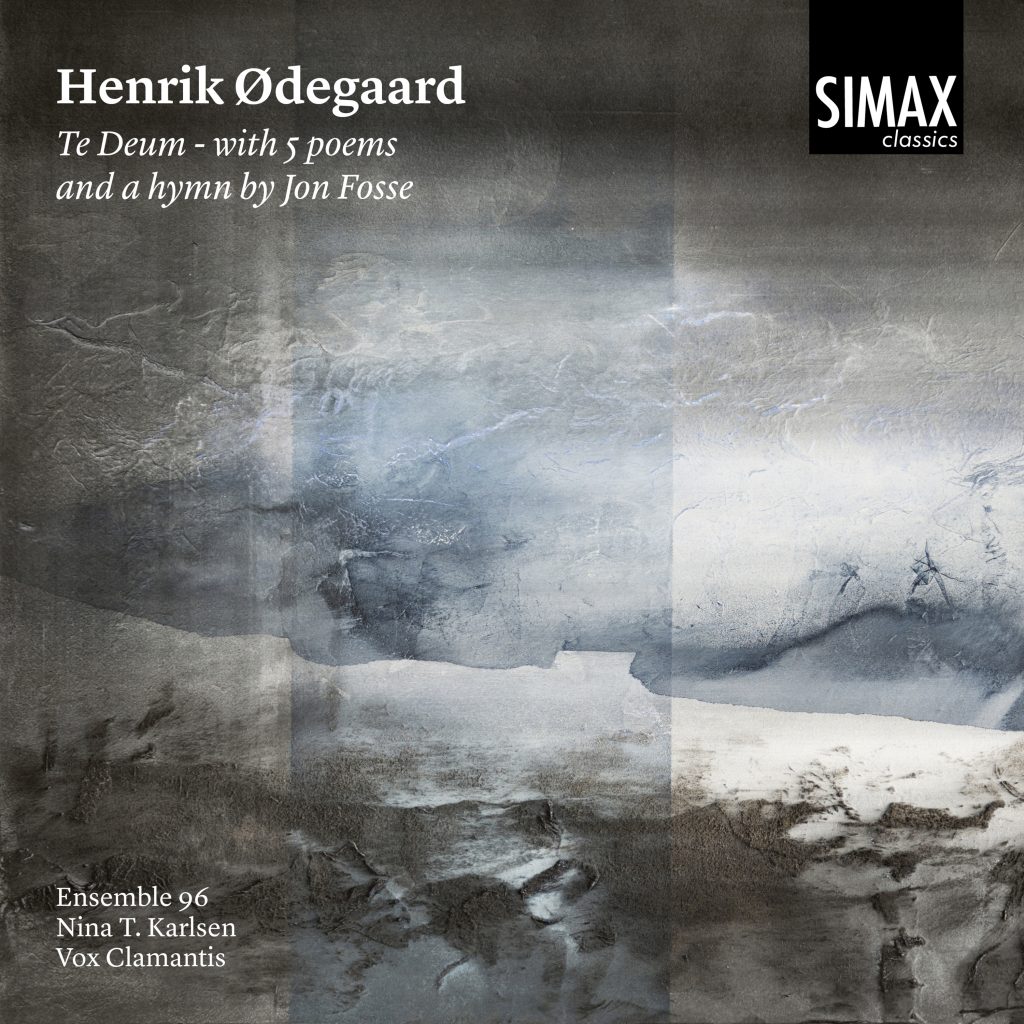
European art music is built on traditions spanning more than a thousand years. Yet much of its living heritage remains hidden -forgotten, silenced, or overlooked. It is in this space between past and present that composer Henrik Ødegaard emerges as a rare voice: an artist who both preserves and renews. With Te Deum with 5 Poems and a Hymn by Jon Fosse, he presents one of his most ambitious and expressive works, a modern oratorio where Gregorian chant, Fosse’s poetry, choral writing, organ, and horn blend into a spiritual and timeless musical universe.
The title work, Te Deum, is a 45-minute composition for two soloists, mixed choir, church organ, and four horns. It alternates between the traditional Latin Te Deum text and five poems and a hymn by Jon Fosse, creating a rich dialogue between medieval liturgy and contemporary poetry. The work unfolds as a modern oratorio in fifteen movements, majestic, mystical, and filled with radiant beauty.
The music opens in an archaic landscape: four natural horns set the scene with resonances that point toward something ancient and timeless. From there, the work expands in power, energy, and spiritual intensity. Ødegaard draws on melodic and rhythmic elements from Gregorian chant, integrating them organically into his own musical language, not as quotations, but as living building blocks. The result is an expression in which old chant and new sonic textures coexist much like contemporary art can find a home inside Gothic cathedrals.
Te Deum was composed in 2019, supported by Arts Council Norway and commissioned by Tønsberg Cathedral Choir and Nina T. Karlsen. It stands as a milestone in Norwegian sacred music -mature, brilliant, and a striking example of the symbiosis between the old and the new.
The album also includes three of Ødegaard’s central instrumental miniatures, each pairing original Gregorian melodies with newly written instrumental paraphrases: Antiphona IV (2007) for solo viola, Antiphona VI (2008) for solo trumpet, and Antiphona VIII (2010) for solo euphonium. Each begins with the chant itself, followed by the composer’s instrumental elaboration. The chants are drawn from the oldest strata of Gregorian tradition: the Introit Ad te levavi(Psalm 24) for the First Sunday of Advent (Antiphona IV), the Alleluia Ascendit Deus in iubilatione (Psalm 46) for Ascension (Antiphona VI), and the Introit Rorate cæli (Isaiah 45:8) for the Fourth Sunday of Advent (Antiphona VIII).
Bringing Gregorian chant into a modern musical culture is an immense challenge that demands sensitivity, taste, and talent. Henrik Ødegaard possesses all these qualities and more. He has studied Gregorian chant since youth, knows it intimately, and loves it passionately.
Henrik Ødegaard (b. 1955) is a composer, organist, and conductor educated in Oslo, Utrecht, and Paris, where he studied Gregorian chant with Louis-Marie Vigne. He has created an extensive catalogue of vocal and sacred music and is particularly known for integrating Gregorian chant and Norwegian folk music into a modern musical language steeped in microtonality and modal structures. His works have been performed by leading ensembles such as the Oslo Philharmonic, Nordic Voices, the Oslo Chamber Choir, and the Estonian National Male Choir, and featured at festivals across Europe, Asia, Africa, and North America. He has received numerous international awards, and his music appears on ECM, Aurora, and Euridice.
Ensemble 96 is known for its strong contemporary music profile and for two GRAMMY nominations (2006 and 2011). The choir has premiered works by a wide range of Norwegian and international composers and is regarded as one of Norway’s foremost professional vocal ensembles. The ensemble is led by Nina T. Karlsen—conductor, pedagogue, and former cathedral cantor in Tønsberg—who has been its artistic director since 2011 and is known for her precise, lyrical, and innovative choral work.
Vox Clamantis, led by Jaan-Eik Tulve, is internationally recognised as one of the world’s leading ensembles for Gregorian chant and early polyphony and received a GRAMMY Award for the album Adam’s Lament (2014). The group performs worldwide and is known for collaborations with major international composers and artists, including Arvo Pärt, Helena Tulve, and Marco Ambrosini.